
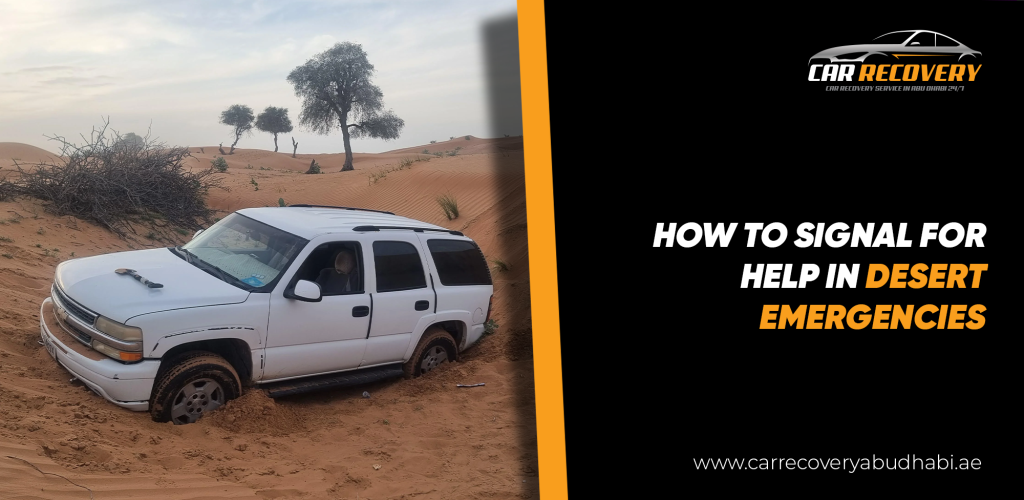
Desert sceneries might be spectacular, yet they are also challenging. Large dunes of sand, the heat and lack of water, can easily transform a simple journey into a nightmare. It may be a simple adventure drive, a long-distance journey over rough roads or off-roading, but understanding how to signal emergency assistance in a desert crisis can determine the difference between a safe rescue and life threatening experience.
Travelers in most desert areas, such as the great dunes of Abu Dhabi, usually experience vehicle failures, poor directions, or abruptly changing environments. While desert recovery Abu Dhabi services can assist stranded drivers, knowing how to draw attention and express distress remains equally significant. You can greatly increase your chances of being spotted with practical signaling techniques. Let’s discuss how to signal for help in desert emergencies.
The desert poses a special kind of challenge to any lost person or one who is stranded. One day it may be hot, and the next day it may be colder than expected. The scanty vegetation and low water supply contribute to the survival problem. Large areas of land can have little mobile coverage or none at all.
Visibility in such circumstances is a challenge and an opportunity. The open terrain makes the rescuers see the signals in distance, but due to the absence of landmarks, the situation may be hard to find out your very position. The rescue is even complicated by wind, sandstorms, and moving dunes.
Another major factor is time. In the absence of timely communication, it can take a day or days before someone realizes that you are absent. Signaling is therefore necessitated. You can become more visible or audible, which is likely to make passing vehicles, aircraft, or search teams locate you faster. Following safety precautions before driving in desert areas and knowing how to signal for help can make the difference between a safe rescue and a life-threatening situation.
To be noticed in the desert, visual cues are generally the most effective way of communication. The open ground allows the signals to be observed at a long distance, particularly in daytime. The easiest one will be to use reflective surfaces like mirrors, metal material or a phone screen and reflect sunlight to produce bright flashes.
Huge markings on the ground also do well. Inscribe HELP or SOS in the sand using stones, branches or any other material. Enlarge the letters so that they can be seen by air. Dark materials on light sand enhance contrast.
Colored clothing, emergency blankets or cloth tied on a stick can also be used as additional signals. Movement attracts attention, and thus the way of waving a cloth or lifting it many times will allow someone to see you at a distance.
Using smoke has long been a method of distress communication. It is also possible to have smoke in the air which is visible over a long distance, particularly during calm days in desert settings.
To create a smoke signal, light a small controlled fire. Dry grass, paper, or other things that are combustible may burn fast. After ignition, place green leaves, a wet cloth, or a rubber to get thick and dark smoke that is easier to see. The darker and heavier the smoke, the more it can be noticed.
Control fire and keep it away from flammable areas. It is aimed at a maintainable column of smoke, rather than a huge fire. Smoke can be particularly useful during daylight, when flames can not necessarily be observed at a great distance.
Although visual is the most important, sound might also be crucial, particularly when rescuers are in the vicinity. Sharp sounds can be heard by whistles, car-horns, or even banging metal that travel across the desert air that is otherwise very quiet.
Sound carries quite a considerable distance in open deserts, especially when there is a calm atmosphere in the early morning or evening. The repetition of an obvious pattern, i.e., three brief blasts or knocks, will assist rescuers in identifying the sound as a distress call. This pattern distinguishes emergency sounds from normal environmental noise.
Shouting is effective only when the person is near; however, save energy and remain hydrated.
A vehicle can be a priceless piece of equipment when it comes to a desert traveler in case of an emergency. A stranded vehicle can be used as shelter and a signaling device. Stay with the car, but if you are absolutely sure help is nearby, you can leave it. Most of the time, the visibility of the vehicle adds to the possibility of being discovered.
Car lights may serve as strong night signals. Switch on hazard lights or headlights to ensure that the vehicle is seen by people at a distance. Flash the lights now and then as long as the battery allows it.
Another less obvious yet helpful signal is opening the hood of the vehicle. It indicates that the vehicle is experiencing mechanical difficulties and tells other drivers that someone might need help. Bright or reflective objects on the roof would also enhance air visibility.
As you are stuck in sand dunes and waiting to get assisted, be visible. Do not walk long distances away since the more you go, the more difficult it will be to locate you. Also, be near your car or a distinctive feature, and chances are high that somebody will notice you.
Attempt to be on the elevated ground, say on top of a dune. Visual and smoke signals can be seen further from an elevated position. Beware of hot weather, and seek shade and keep cool.
Make some temporary shade with fabric, tarps, or portions of your vehicle. This will save energy and assist you in saving stamina. Be focused, calm. This keeps your thinking on track, and you will be able to deal with the situation.
Modern technology has made desert travel safer than it was before with GPS positioners, satellite phones and emergency beacons. The mobile networks may fail, but the satellite devices do not.
Several off-roaders install a GPS tracker to allow the family or rescue teams to monitor their position. This saves time in case of an emergency when you are to be found.
Technology can be handy, yet it is not to be used in place of old-school signals. Batteries may fail, devices may be broken, and electronics may be damaged by sand or heat. Being familiar with the method of manual signaling provides you with choices in case of a technological breakdown.
The majority of emergencies that occur in the desert are a result of a car that has broken down or gotten stuck in thick sand. A dependable sand recovery service can be of great importance in such situations.
The professional services attend to vehicles that are stuck within the city roads and in isolated desert locations. Their teams have special equipment for the recovery of sand, towing and roadside assistance. Whenever a car is trapped in soft dunes, has mechanical problems or has battery problems, these professionals save lives and provide efficiency.
When you call a desert breakdown team, it will ease the stress, and your exposure to the brutal conditions of the desert will be minimized as you await their arrival.
Traveling in the desert is an experience that one will never forget, and at the same time, one needs to view environmental challenges with respect. Remote area emergencies can occur at any time. In addition, the large area can slow rescue efforts unless appropriate signaling methods are employed.
The more you know how to attract attention with the help of visual signs, smoke, sound and car signals, the more likely you will be found early. Combined with modern technology and professional desert recovery services, even critical situations become manageable.
The most potent tools of a person setting out to explore the desert are preparedness, awareness, and calm decision-making. Knowing how to express distress and be heard, travelers will be able to remain safer and react more decisively in case of an emergency.
WhatsApp us